FME Transformers: 2026.3
 Categories and Related Transformers
Categories
Geometries
Related Transformers
GeometryCopier
GeometryExposer
GeometryExtractor
GeometryNameExtractor
GeometryRemover
GeometryReplacer
MultipleGeometryFilter
GeometryNameSetter
Applies names to geometries.
Typical Uses
- Preparing features for multiple geometries by applying unique names.
How does it work?
The GeometryNameSetter receives features of any type and applies a name to selected, all, or only unnamed geometries.
If features with multiple geometries are to have <All Geometries> renamed to the value of Geometry Name, then each of the geometries will be indexed to keep the names unique.
If a Geometry Name is provided that already exists on the feature, the existing geometry is deleted and the Geometry Selection is renamed to Geometry Name.
Examples
Example: Naming geometry
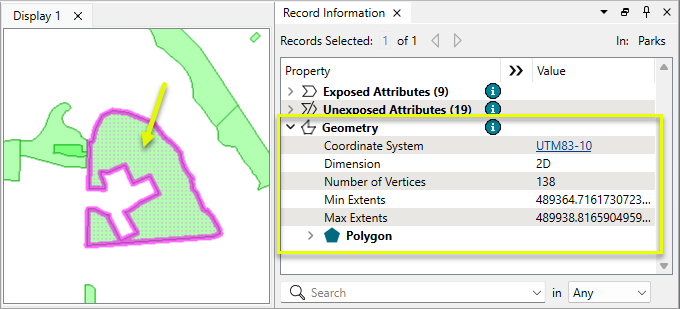
In this example, we have a set of park areas. Note that the features are in a UTM coordinate system. We want to prepare these features for some further processing by giving the original geometry a meaningful name.
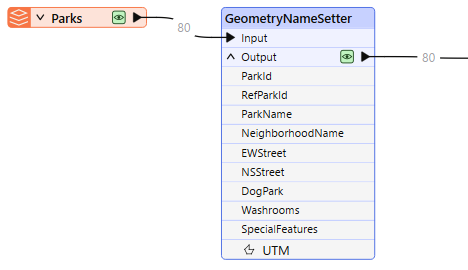
The features are routed into a GeometryNameSetter.
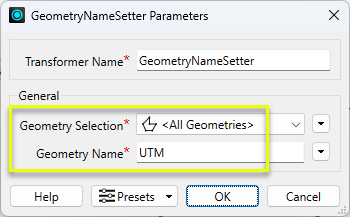
In the parameters dialog, the name UTM is applied to all of the incoming geometry.
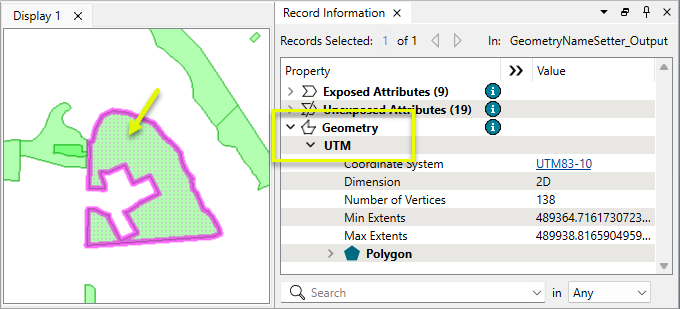
The output features now have one named geometry.
Usage Notes
Working with Multiple Geometries
Some formats, such as PostGIS, Oracle Spatial, and Microsoft SQL Server, support multiple geometries on a feature.
They must have unique names, and they have their own coordinate systems and a separate row in the Geometry Definition table.
Multiple geometries are a different concept from aggregates and multis such as MultiPoint.
Multiple Geometries Transformers
|
Transformer |
Use this to... |
|---|---|
|
Add a copy of a feature’s geometry onto itself, either creating or adding to multiple geometry. The copy can then be further processed. |
|
|
Create multiple geometries by merging features based on attribute values and expressions. See Geometry Merge Type > Preserve Distinct Geometries. |
|
|
Create multiple geometries by joining features on attribute values, using left, inner, or full joins. See Geometry Handling > Keep Both (Preserve Distinct Geometries). |
|
|
Assign names to geometries. |
|
|
Put all geometry names into an attribute or list attribute. |
|
|
Make a name available for geometry selection when it is not yet available to downstream transformers. |
|
|
Identify and route features that have multiple geometries. |
|
|
Remove specific geometries by name, or all geometries. Useful for going from multiple geometries to single. |
|
|
Place specific or all geometries into an attribute as a blob. May be useful when paired with the GeometryReplacer for performing transformations on geometry with transformers that do not have geometry selection. |
|
|
Restore geometry from an attribute blob value. |
Transformers with Geometry Selection
These transformers can operate on selected geometries.
Configuration
Input Ports
Input
Features with geometries.
Output Ports
Output
Features with newly set or overwritten geometry names.
<Rejected> (Dynamic)
The dynamic <Rejected> port appears when a parameter is set to a non-literal value that might make processing impossible.
For example, if a numeric parameter such as Line Width, Count Start, or Decimal Places is set to an expression, attribute value, or user parameter, it is possible to pass in a non-numeric value that cannot be used. Decimal Places = Cat cannot be processed, so the feature will be output via this port.
Rejected features will have an fme_rejection_code attribute with one of the following values, along with a more descriptive fme_rejection_message:
INVALID_STRING_ENCODING
MISSING_FEATURE_ATTRIBUTES
Rejected Feature Handling: can be set to either terminate the translation or continue running when it encounters a rejected feature. This setting is available both as a default FME option and as a workspace parameter.
Parameters
General
|
Geometry Selection |
Select the geometry to be renamed. The selectable options will reflect the geometries available from the input features. If input features contain nameless geometries, <geometry> is also available:
|
|
Geometry Name |
Provide a name for the geometry. |
Editing Transformer Parameters
Transformer parameters can be set by directly entering values, using expressions, or referencing other elements in the workspace such as attribute values or user parameters. Various editors and context menus are available to assist. To see what is available, click  beside the applicable parameter.
How to Set Parameter Values
Defining Values
There are several ways to define a value for use in a Transformer. The simplest is to simply type in a value or string, which can include functions of various types such as attribute references, math and string functions, and workspace parameters.
Using the Text Editor
The Text Editor provides a convenient way to construct text strings (including regular expressions) from various data sources, such as attributes, parameters, and constants, where the result is used directly inside a parameter.
Using the Arithmetic Editor
The Arithmetic Editor provides a convenient way to construct math expressions from various data sources, such as attributes, parameters, and feature functions, where the result is used directly inside a parameter.
Conditional Values
Set values depending on one or more test conditions that either pass or fail.
Parameter Condition Definition Dialog
Content
Expressions and strings can include a number of functions, characters, parameters, and more.
When setting values - whether entered directly in a parameter or constructed using one of the editors - strings and expressions containing String, Math, Date/Time or FME Feature Functions will have those functions evaluated. Therefore, the names of these functions (in the form @<function_name>) should not be used as literal string values.
Content Types
| These functions manipulate and format strings. | |
|
Special Characters |
A set of control characters is available in the Text Editor. |
| Math functions are available in both editors. | |
| Date/Time Functions | Date and time functions are available in the Text Editor. |
| These operators are available in the Arithmetic Editor. | |
| These return primarily feature-specific values. | |
| FME and workspace-specific parameters may be used. | |
| Creating and Modifying User Parameters | Create your own editable parameters. |
Dialog Options - Tables
Table Tools
Transformers with table-style parameters have additional tools for populating and manipulating values.
|
Row Reordering
|
Enabled once you have clicked on a row item. Choices include:
|
|
Cut, Copy, and Paste
|
Enabled once you have clicked on a row item. Choices include:
Cut, copy, and paste may be used within a transformer, or between transformers. |
|
Filter
|
Start typing a string, and the matrix will only display rows matching those characters. Searches all columns. This only affects the display of attributes within the transformer - it does not alter which attributes are output. |
|
Import
|
Import populates the table with a set of new attributes read from a dataset. Specific application varies between transformers. |
|
Reset/Refresh
|
Generally resets the table to its initial state, and may provide additional options to remove invalid entries. Behavior varies between transformers. |




Note: Not all tools are available in all transformers.
For more information, see Transformer Parameter Menu Options.
Reference
|
Processing Behavior |
|
|
Feature Holding |
No |
| Dependencies | None |
| Aliases | |
| History |
FME Online Resources
The FME Community and Support Center Knowledge Base have a wealth of information, including active forums with 35,000+ members and thousands of articles.
Search for all results about the GeometryNameSetter on the FME Community.
Examples may contain information licensed under the Open Government Licence – Vancouver, Open Government Licence - British Columbia, and/or Open Government Licence – Canada.