 Overwrite Database
- No (default) – If the writer attempts to write to an existing file, the translation will be aborted.
- Yes – Any existing database is deleted before writing begins.
If no database exists when writing begins, a new database is created.
Metadata
Tileset Name
Defines the tileset name and is used to fill metadata records. Defaults to the basename of the output file/directory.
Tileset Description
Defines the tileset description and is written to the metadata.json file.
This parameter is optional and defaults to an empty description.
Layer Type
Used to fill metadata records.
Spatial
Coordinate System
Coordinate systems may be extracted from input feature data sources, may come predefined with FME, or may be user-defined. FME allows different output and input coordinate systems, and performs the required coordinate conversions when necessary.
If a coordinate system is specified in both the source format and the workspace, the coordinate system in the workspace is used. The coordinate system specified in the source format is not used, and a warning is logged. If a source coordinate system is not specified in the workspace and the format or system does not store coordinate system information, then the coordinate system is not set for the features that are read.
If a destination coordinate system is set and the feature has been tagged with a coordinate system, then a coordinate system conversion is performed to put the feature into the destination system. This happens right before the feature enters into the writer.
If the destination coordinate system was not set, then the features are written out in their original coordinate system.
If a destination coordinate system is set, but the source coordinate system was not specified in the workspace or stored in the source format, then no conversion is performed. The features are simply tagged with the output system name before being written to the output dataset.
For systems that know their coordinate system, the Coordinate System field will display Read from Source and FME will read the coordinate system from the source dataset. For most other input sources, the field will display Unknown (which simply means that FME will use default values). In most cases, the default value is all you'll need to perform the translation.
You can always choose to override the defaults and choose a new coordinate system. Select More Coordinate Systems from the drop-down menu to open the Coordinate System Gallery.
Changing a Reprojection
To perform a reprojection, FME typically uses the CS-MAP reprojection engine, which includes definitions for thousands of coordinate systems, with a large variety of projections, datums, ellipsoids, and units. However, GIS applications have slightly different algorithms for reprojecting data between different coordinate systems. To ensure that the data FME writes matches exactly to your existing data, you can use the reprojection engine from a different application.
To change the reprojection engine, Select Workspace Parameters > Spatial > Reprojection Engine. In the example shown, you can select Esri (but the selection here depends on your installed applications):
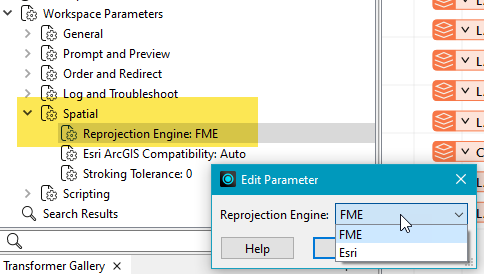
- The coordinate systems file coordsys.db in the FME installation folder contains the names and descriptions of all predefined coordinate systems.
- Some users may wish to use coordinate systems that do not ship with FME, and in those cases, FME also supports custom coordinate systems.
- Learn more about Working with Coordinate Systems in FME.
Zoom Levels
Minimum Zoom Level
The required minimum zoom level at which a tileset will be generated.
Note that specific tile files within the zoom level will only be generated if input geometries exist within those tiles.
Default: 0
For more information about zoom levels, see Mapbox Documentation.
Maximum Zoom Level
The required maximum zoom level at which a tileset will be generated.
The maximum supported value is 22. Note that specific tile files within the zoom level will only be generated if input geometries exist within those tiles.
Default: 5
Maximum supported value: 22
For more information about zoom levels, see Mapbox Documentation.
Tile Size
Number of Units per Tile
Number of units in a tile. A higher number of units results in more accurate geometry coordinates (at the expense of tile byte size).
Default: 4096
Number of Tile Buffer Units
Number of units for geometry buffering. This value corresponds to a buffer around each side of a tile into which geometries are fetched and clipped.
Default: 80 if Number of Units per Tile is 4096
Max Tile Size (bytes)
Maximum size of a tile in bytes (after compression).
If a tile is greater than this threshold, features will be written with reduced precision, or discarded and warnings will be logged.
Default: 500000
Max Features Per Tile
Maximum number of features per tile.
Default: 200000
Override Calculated Tile Bounds
By default, the bounds of the dataset is stored in the metadata.json file and in calculated automatically based on the bounds of the incoming vector feature geometries. This set of options allows overriding of those default bounds.
- Minimum Tile Longitude – The optional minimum longitude coordinate for the dataset bounds.
- Minimum Tile Latitude – The optional minimum latitude coordinate for the dataset bounds.
- Maximum Tile Longitude – The optional maximum longitude coordinate for the dataset bounds.
- Maximum Tile Latitude – The optional maximum latitude coordinate for the dataset bounds.
Override Calculated Tile Center
By default, the center of the dataset is stored in the metadata.json file and is calculated automatically based on the bounds of the incoming vector feature geometries.
- Center Longitude – The optional longitude coordinate for the dataset center.
- Center Latitude – The optional latitude coordinate for the dataset center.
- Center Zoom Level – The zoom level for which the Center Longitude and Center Latitude Apply.
Advanced
Simplification Factor
Simplification factor for linear or polygonal geometries. The unit is the integer unit of tiles after quantification of geometry coordinates to tile coordinates.
Applies to all zoom levels, unless Simplification Factor Max Zoom Level is also defined.
Simplification Factor Max Zoom Level
Simplification factor for linear or polygonal geometries (which applies only to the maximum zoom level).
Specific Number of Threads
The number of threads to use in the translation.
To set a specific number of threads, set this parameter to any positive whole integer value from 0-64.
If this parameter is left blank (which is the default), the default CPU number of threads will be used.