FME considers a dataset to be a folder name, and the feature type of each dataset is the filename.
The Mojang Minecraft writer will delete any Minecraft files present in the folder before writing.
Terrain Generation
 Populate Terrain
Allows Minecraft to modify some of your blocks and generate structures, ores, and lakes among other game features. This may change some of your selected blockIDs.
Default: No
Fill Under Point Cloud
Creates extra points to fill in empty space below the dataset. Uses the fill block ID to generate the extra terrain.
Default: No
Center Point Cloud at 0,0
Offsets the point cloud to (0, 0). This operation does not modify the z-components.
Default: Yes
Biome
Sets the biome of the Minecraft world. The biome controls various geographic features such as the temperature, humidity, and sky/foliage colors.
Default: Plains
Generator Settings
Generator Name
Defines the type of terrain generation to occur outside of the bounds of the dataset.
The default uses generic Minecraft generation.
- Large Biomes makes the Biomes more expansive.
- Amplified consists of many large hills and mountains.
- Flat generates a flat terrain, which uses the Generator Options parameter.
Generator Options
Additional options for the generator when “flat” generator name is selected.
Select from common presets such as Classic Flat, Redstone Ready, and Bottomless Pit, or add custom generation strings.
Default: Classic Flat
Spatial
Coordinate System
Coordinate systems may be extracted from input feature data sources, may come predefined with FME, or may be user-defined. FME allows different output and input coordinate systems, and performs the required coordinate conversions when necessary.
If a coordinate system is specified in both the source format and the workspace, the coordinate system in the workspace is used. The coordinate system specified in the source format is not used, and a warning is logged. If a source coordinate system is not specified in the workspace and the format or system does not store coordinate system information, then the coordinate system is not set for the features that are read.
If a destination coordinate system is set and the feature has been tagged with a coordinate system, then a coordinate system conversion is performed to put the feature into the destination system. This happens right before the feature enters into the writer.
If the destination coordinate system was not set, then the features are written out in their original coordinate system.
If a destination coordinate system is set, but the source coordinate system was not specified in the workspace or stored in the source format, then no conversion is performed. The features are simply tagged with the output system name before being written to the output dataset.
For systems that know their coordinate system, the Coordinate System field will display Read from Source and FME will read the coordinate system from the source dataset. For most other input sources, the field will display Unknown (which simply means that FME will use default values). In most cases, the default value is all you'll need to perform the translation.
You can always choose to override the defaults and choose a new coordinate system. Select More Coordinate Systems from the drop-down menu to open the Coordinate System Gallery.
Changing a Reprojection
To perform a reprojection, FME typically uses the CS-MAP reprojection engine, which includes definitions for thousands of coordinate systems, with a large variety of projections, datums, ellipsoids, and units. However, GIS applications have slightly different algorithms for reprojecting data between different coordinate systems. To ensure that the data FME writes matches exactly to your existing data, you can use the reprojection engine from a different application.
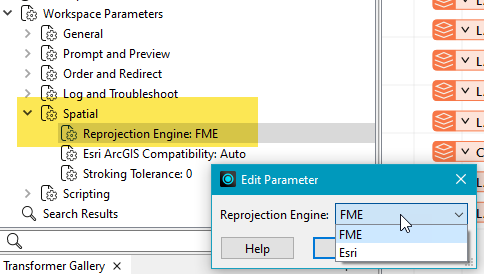
To change the reprojection engine, Select Workspace Parameters > Spatial > Reprojection Engine. In the example shown, you can select Esri (but the selection here depends on your installed applications):
- The coordinate systems file coordsys.db in the FME installation folder contains the names and descriptions of all predefined coordinate systems.
- Some users may wish to use coordinate systems that do not ship with FME, and in those cases, FME also supports custom coordinate systems.
- Learn more about Working with Coordinate Systems in FME.
Advanced
Fill Block
The blockID used for Fill Under.
Default: 1 (Stone)