Database Connection
 GeoPackage File
The path to the destination GeoPackage file.
Overwrite Existing Database
- When unchecked (default) and a database already exists, then tables and features are written to the existing database.
- When checked, any existing database is deleted before writing begins. Checking this option also enables the Template File parameter.
If a database does not exist when writing begins, a new database is created.
Writer Parameters
Version
Sets the GeoPackage version (application_id and user_version fields).
Tile Format Parameters
The data format of the binary tile data stored in the tile table.
|
Tile Format Options |
Description |
Default Value |
|---|---|---|
|
Auto (default) |
When the Tile Format is Auto, the writer will use:
|
|
|
JPEG or WEBP |
Setting the Tile Format to JPEG or WEBP enables the JPEG/WEBP Compression Level parameter. This sets the desired compression level of the output images. This is expressed as a percentage of the original file size. For example, setting a compression level of 75 means that the output image will be approximately 75% smaller (one-quarter of the size) than an uncompressed image. Value: The level of compression that is used, from 1-100. The gpkg_webp extension will be registered in the GeoPackage. Note Repeatedly reading and saving files may decrease the quality for this format. In addition, FME Workbench may not know which format data comes from, and whether it used lossy compression. If you know that source data comes from files with lossy compression, you should also set the compression level to 0. Although this compression still does not guarantee the exact copy of the source file, the output will be very close to the original.
|
|
|
PNG |
Setting the Tile Format to PNG, enables the PNG Compression Level parameter. This sets the PNG DEFLATE compression level. Must be a value from 1-9. |
6 |
|
PNG8 |
Setting the Tile Format to PNG8 enables the PNG8 Dither parameter, which determines if the PNG8 data will use Floyd-Steinberg dithering. Floyd-Steinberg dithering is an algorithm that reduces the color palette of an image while preserving as much image detail as possible.
|
No |
|
TIFF |
If Tile Format is set to TIFF, then the gpkg_2d_gridded_coverage extension will be registered in the GeoPackage, and only single-band Real32 rasters will be written. |
|
Tiling Scheme Parameters
|
Parameter |
Description |
Default |
|---|---|---|
|
Tiling Scheme |
To enable the use of GeoPackage with tile servicing software, you can select a predefined tiling scheme:
In all the above tiling schemes, consecutive zoom levels defer by a resolution of a factor of two. |
GoogleMapsCompatible |
|
Interpolation Type |
Determines the resampling algorithm used:
|
Bilinear |
|
Base Zoom Level Strategy |
Sets the strategy used to determine the zoom level:
|
Auto |
|
Generate Zoom Levels |
Determines whether to create additional zoom levels by resampling the original raster:
|
No |
|
Minimum Zoom Level |
Determines the least-resolute zoom level to generate when Generate Zoom Levels is set to Yes. |
0, which is the lowest possible zoom level |
Tiled Gridded Coverage Parameters
Tiled Gridded Coverages parameters only apply to single-band rasters with an interpretation that is one of:
- UInt16
- Int16
- Real32
These rasters will be written as a Tiled Gridded Coverage, according to the gpkg_2d_gridded_coverage extension.
|
Parameter |
Description |
Default |
|---|---|---|
|
Precision |
The smallest cell value that has meaning for the tiled gridded coverage. |
1 |
|
Grid Cell Encoding |
Describes how the value of each cell is related to the bounds of the cell. Standard values include:
|
grid-value-is-center |
|
Unit of Measure |
The unit for cell values in the tiled gridded coverage. The value for this parameter should be a symbol from The Unified Code for Units of Measure. For example, Cel is used for degrees Celsius in a temperature coverage. If no value is specified, then the unit from the raster’s coordinate system will be assumed. |
None |
|
Field Name |
The name that describes the data in the tiled gridded coverage. For example, a coverage of air temperature may use the field name Temperature. |
Height |
|
Quantity Definition |
The description of the field of data in the tiled gridded coverage. This parameter expands upon the Field Name to add extra context or a link to a more in-depth definition. For example, the Marine Metadata registry uses the following definition for an Air Temperature field: Air temperature is the bulk temperature of the air, not the surface (skin) temperature. |
Height |
Spatial
Coordinate System
Coordinate systems may be extracted from input feature data sources, may come predefined with FME, or may be user-defined. FME allows different output and input coordinate systems, and performs the required coordinate conversions when necessary.
If a coordinate system is specified in both the source format and the workspace, the coordinate system in the workspace is used. The coordinate system specified in the source format is not used, and a warning is logged. If a source coordinate system is not specified in the workspace and the format or system does not store coordinate system information, then the coordinate system is not set for the features that are read.
If a destination coordinate system is set and the feature has been tagged with a coordinate system, then a coordinate system conversion is performed to put the feature into the destination system. This happens right before the feature enters into the writer.
If the destination coordinate system was not set, then the features are written out in their original coordinate system.
If a destination coordinate system is set, but the source coordinate system was not specified in the workspace or stored in the source format, then no conversion is performed. The features are simply tagged with the output system name before being written to the output dataset.
For systems that know their coordinate system, the Coordinate System field will display Read from Source and FME will read the coordinate system from the source dataset. For most other input sources, the field will display Unknown (which simply means that FME will use default values). In most cases, the default value is all you'll need to perform the translation.
You can always choose to override the defaults and choose a new coordinate system. Select More Coordinate Systems from the drop-down menu to open the Coordinate System Gallery.
Changing a Reprojection
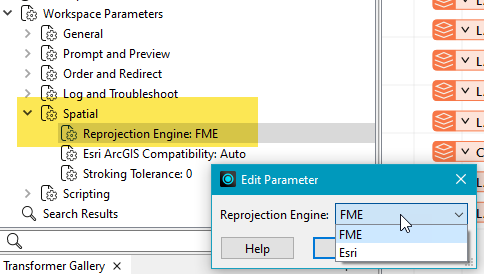
To perform a reprojection, FME typically uses the CS-MAP reprojection engine, which includes definitions for thousands of coordinate systems, with a large variety of projections, datums, ellipsoids, and units. However, GIS applications have slightly different algorithms for reprojecting data between different coordinate systems. To ensure that the data FME writes matches exactly to your existing data, you can use the reprojection engine from a different application.
To change the reprojection engine, Select Workspace Parameters > Spatial > Reprojection Engine. In the example shown, you can select Esri (but the selection here depends on your installed applications):
- The coordinate systems file coordsys.db in the FME installation folder contains the names and descriptions of all predefined coordinate systems.
- Some users may wish to use coordinate systems that do not ship with FME, and in those cases, FME also supports custom coordinate systems.
- Learn more about Working with Coordinate Systems in FME.
Advanced
Temporary Database Location
Determines where to store the temporary database while processing tiles.
- On Disk (Default) – A temporary file will be created to process partial tiles. This mode is more reliable, but may be slower.
- In Memory – A temporary database will be created entirely within memory. This mode is usually faster, but may be more susceptible to failure due to lack of system resources.
Temporary Database Cache Size (MB)
Determines the size in megabytes of the cache for the On Disk temporary database. If temporary database location is In Memory, then this parameter will be ignored.
The default cache size is 2.