Point Cloud Component Mapping
Use this matrix to map FME point cloud components to E57 element names.
Each point cloud may contain an arbitrary set of components, and each component may have an arbitrary data type. For example, /data3D/0/points/colorRed could be mapped to FME component color_red.
The table below lists the set of standard E57 component names, and the corresponding default FME component name:
| E57 Element | FME Component |
|---|---|
| cartesianX | x |
| cartesianY | y |
| cartesianZ | z |
| sphericalRange | sphericalRange |
| sphericalAzimuth | sphericalAzimuth |
| sphericalElevation | sphericalElevation |
| rowIndex | rowIndex |
| columnIndex | columnIndex |
| returnCount | number_of_returns |
| returnIndex | return |
| timeStamp | timeStamp |
| intensity | intensity |
| colorRed | color_red |
| colorGreen | color_green |
| colorBlue | color_blue |
| cartesianInvalidState | cartesianInvalidState |
| sphericalInvalidState | sphericalInvalidState |
| isTimeStampInvalid | isTimeStampInvalid |
| isIntensityInvalid | isIntensityInvalid |
Point clouds in E57 may have either Cartesian coordinates or spherical coordinates. If a dataset only contains spherical coordinates, the cartesianX, cartesianY, and cartesianZ elements may still be selected as part of the component map (in which case the spherical values will be converted to Cartesian values).
Write Point Groups
Point clouds written to E57 can be split into logical groups of points. Splitting a point cloud into groups may allow an application reading an E57 dataset to filter points more quickly.
- Unchecked (default) – Do not split point clouds into groups.
- When checked – Split point clouds into groups.
 Group By Element
Specifies the E57 element by which the points will be grouped, either by rowIndex or columnIndex.
Each distinct value for the specified element defines a group. For example, if grouping by rowIndex, and the input point cloud has points with rowIndex values of 0, 1, and 2, three groups are created. Group values are not required to be consecutive or sorted. For example, it is permissible to have two groups, with values of 6 then 4.
The specified element must exist in the component map. If the corresponding component is not present on an input point cloud, groups are not written for that point cloud.
Create Contiguous Point Groups
Specifies whether point groups should be contiguous. In contiguous point groups, all points in a group are consecutive.
For example, there would not be points for group 0, followed by points for group 1, followed by more points for group 0. Contiguous groups may allow an application reading an E57 dataset to filter points more quickly that non-contiguous groups.
Points are Ordered By Group
When creating contiguous point groups, specifies whether the points are already ordered.
- No – Points are not assumed to be ordered, so the writer enforces order.
- Yes – Points are assumed to be already ordered. If the points are, in fact, already ordered, this option improves performance. If they are not ordered, the writer fails.
Raster
Default Raster Format
Specifies the underlying format to which rasters are written.
Spatial
Coordinate System
Coordinate systems may be extracted from input feature data sources, may come predefined with FME, or may be user-defined. FME allows different output and input coordinate systems, and performs the required coordinate conversions when necessary.
If a coordinate system is specified in both the source format and the workspace, the coordinate system in the workspace is used. The coordinate system specified in the source format is not used, and a warning is logged. If a source coordinate system is not specified in the workspace and the format or system does not store coordinate system information, then the coordinate system is not set for the features that are read.
If a destination coordinate system is set and the feature has been tagged with a coordinate system, then a coordinate system conversion is performed to put the feature into the destination system. This happens right before the feature enters into the writer.
If the destination coordinate system was not set, then the features are written out in their original coordinate system.
If a destination coordinate system is set, but the source coordinate system was not specified in the workspace or stored in the source format, then no conversion is performed. The features are simply tagged with the output system name before being written to the output dataset.
For systems that know their coordinate system, the Coordinate System field will display Read from Source and FME will read the coordinate system from the source dataset. For most other input sources, the field will display Unknown (which simply means that FME will use default values). In most cases, the default value is all you'll need to perform the translation.
You can always choose to override the defaults and choose a new coordinate system. Select More Coordinate Systems from the drop-down menu to open the Coordinate System Gallery.
Changing a Reprojection
To perform a reprojection, FME typically uses the CS-MAP reprojection engine, which includes definitions for thousands of coordinate systems, with a large variety of projections, datums, ellipsoids, and units. However, GIS applications have slightly different algorithms for reprojecting data between different coordinate systems. To ensure that the data FME writes matches exactly to your existing data, you can use the reprojection engine from a different application.
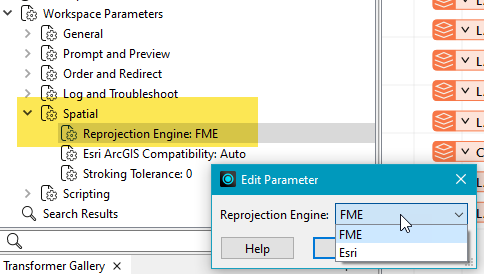
To change the reprojection engine, Select Workspace Parameters > Spatial > Reprojection Engine. In the example shown, you can select Esri (but the selection here depends on your installed applications):
- The coordinate systems file coordsys.db in the FME installation folder contains the names and descriptions of all predefined coordinate systems.
- Some users may wish to use coordinate systems that do not ship with FME, and in those cases, FME also supports custom coordinate systems.
- Learn more about Working with Coordinate Systems in FME.