Texture/Material
 Output Texture Folder
The folder to write texture files referenced by the COLLADA .dae files. The texture output folder is generally a subfolder of the output dataset but can be any path relative to the output dataset. All texture image files for the dataset being produced will be written to this folder.
Textured appearances that are shared between feature types of the same dataset will produce COLLADA materials in different .dae files that share the same texture image file. Texture file names are based on the fme appearance name.
Existing old files of the same name from another run or another dataset will be overwritten with new files of the same name.
Write Texture List Files
When set to Yes, .txt file will be created that contains a list of external texture files used in the corresponding .dae file. The texture list file will have the same base name as the corresponding .dae file but will have the _texture.txt suffix added.
For example, the external texture names for
c:\data\collada\house.dae
will be in a file called
c:\data\collada\house_textures.txt
and texture names for
c:\data\collada\barn.dae
will be in a file called
c:\data\collada\barn_textures.txt
If "house" and "barn" features share textured appearances, then the shared texture name will be both <feature_type> and _textures.txt files.
Preferred Texture Format
Specifies the preferred format for associated texture files. This preference will be used as long as the specified format supports the properties of the texture raster; if not, it will be overridden.
Possible values are:
- Auto (default) – The writer chooses the best representation based on the incoming texture raster.
- BMP
- GIF
- JPEG
- PNG
- TIFF
- XPM
If the preferred format is ignored, a message is added to the log file. Possible reasons that the preference will be ignored include a lack of raster palette support, alpha channel support, or color depth support in the selected format.
Optimization
Triangulate Output Geometry
- Yes – All geometries will be triangulated before being written. Geometries will be output with the COLLADA triangles primitive type. Most applications that import COLLADA datasets support this primitive type.
- No – Geometries will be written using the COLLADA primitive that most suits their original type. Please note that not all applications that import COLLADA datasets will support all primitive types.
Spatial
Coordinate System
Coordinate systems may be extracted from input feature data sources, may come predefined with FME, or may be user-defined. FME allows different output and input coordinate systems, and performs the required coordinate conversions when necessary.
If a coordinate system is specified in both the source format and the workspace, the coordinate system in the workspace is used. The coordinate system specified in the source format is not used, and a warning is logged. If a source coordinate system is not specified in the workspace and the format or system does not store coordinate system information, then the coordinate system is not set for the features that are read.
If a destination coordinate system is set and the feature has been tagged with a coordinate system, then a coordinate system conversion is performed to put the feature into the destination system. This happens right before the feature enters into the writer.
If the destination coordinate system was not set, then the features are written out in their original coordinate system.
If a destination coordinate system is set, but the source coordinate system was not specified in the workspace or stored in the source format, then no conversion is performed. The features are simply tagged with the output system name before being written to the output dataset.
For systems that know their coordinate system, the Coordinate System field will display Read from Source and FME will read the coordinate system from the source dataset. For most other input sources, the field will display Unknown (which simply means that FME will use default values). In most cases, the default value is all you'll need to perform the translation.
You can always choose to override the defaults and choose a new coordinate system. Select More Coordinate Systems from the drop-down menu to open the Coordinate System Gallery.
Changing a Reprojection
To perform a reprojection, FME typically uses the CS-MAP reprojection engine, which includes definitions for thousands of coordinate systems, with a large variety of projections, datums, ellipsoids, and units. However, GIS applications have slightly different algorithms for reprojecting data between different coordinate systems. To ensure that the data FME writes matches exactly to your existing data, you can use the reprojection engine from a different application.
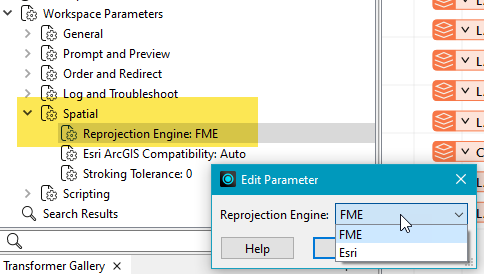
To change the reprojection engine, Select Workspace Parameters > Spatial > Reprojection Engine. In the example shown, you can select Esri (but the selection here depends on your installed applications):
- The coordinate systems file coordsys.db in the FME installation folder contains the names and descriptions of all predefined coordinate systems.
- Some users may wish to use coordinate systems that do not ship with FME, and in those cases, FME also supports custom coordinate systems.
- Learn more about Working with Coordinate Systems in FME.
Move to Local Coordinate System
Note that the options described below are not available in all formats.
- Yes – Coordinates of all the points in the written features will be normalized to the interval [-0.5, 0.5] on the largest side of their XYZ-bounding cube. The other dimensions will be scaled proportionally. Additionally, the transformation matrix required to scale the model back to world coordinates will be written to a companion .fwt file. This can be used to improve precision of the written coordinates. The companion .fwt file will have the same name as the primary data file and will be written in the same folder. For folder-based formats, the file global.fwt will be written instead.
- No – The original coordinates will be written as provided. Coordinates will not be projected; .fwt world and .prj files will not be generated.
- Create Projection File Only – A companion .prj file containing the coordinate system and having the same name as the primary data file will be written in the same folder. For folder-based formats, the file global.prj will be written instead. Coordinates will not be projected and a world file will not be generated.
- Transform Coordinates Only – Transforms the coordinates as in the Yes option, but companion .prj and .fwt world files will not be generated.