Database Connection
 File Knowledge Graph
Select a file knowledge graph.
Overwrite Existing Knowledge Graph
- When unchecked (default) and a knowledge graph already exists, then tables and features are written to the existing knowledge graph.
- When checked, any existing knowledge graph is deleted before writing begins. Checking this option also enables the Template Knowledge Graph parameter.
If a knowledge graph does not exist when writing begins, a new knowledge graph is created.
Template Knowledge Graph
If a knowledge graph is specified, the writer will make a copy of the template into the location specified in the Writer Dataset parameter. All operations will be performed on the copy while the original knowledge graph remains unchanged.
The parameter is available only when Overwrite Existing Knowledge Graph is enabled.
Case Conversion
These parameters change the case of all feature type and attribute names in the output.
Feature Type Names
- UPPERCASE – Change all feature type names to uppercase text.
- lowercase – Change all feature type names to lowercase text.
- None – Do not make changes to any feature type names.
Attribute Names
- UPPERCASE – Change all attribute names to uppercase text.
- lowercase – Change all attribute names to lowercase text.
- None – Do not make changes to any attribute names.
Spatial
Coordinate System
Coordinate systems may be extracted from input feature data sources, may come predefined with FME, or may be user-defined. FME allows different output and input coordinate systems, and performs the required coordinate conversions when necessary.
If a coordinate system is specified in both the source format and the workspace, the coordinate system in the workspace is used. The coordinate system specified in the source format is not used, and a warning is logged. If a source coordinate system is not specified in the workspace and the format or system does not store coordinate system information, then the coordinate system is not set for the features that are read.
If a destination coordinate system is set and the feature has been tagged with a coordinate system, then a coordinate system conversion is performed to put the feature into the destination system. This happens right before the feature enters into the writer.
If the destination coordinate system was not set, then the features are written out in their original coordinate system.
If a destination coordinate system is set, but the source coordinate system was not specified in the workspace or stored in the source format, then no conversion is performed. The features are simply tagged with the output system name before being written to the output dataset.
For systems that know their coordinate system, the Coordinate System field will display Read from Source and FME will read the coordinate system from the source dataset. For most other input sources, the field will display Unknown (which simply means that FME will use default values). In most cases, the default value is all you'll need to perform the translation.
You can always choose to override the defaults and choose a new coordinate system. Select More Coordinate Systems from the drop-down menu to open the Coordinate System Gallery.
Changing a Reprojection
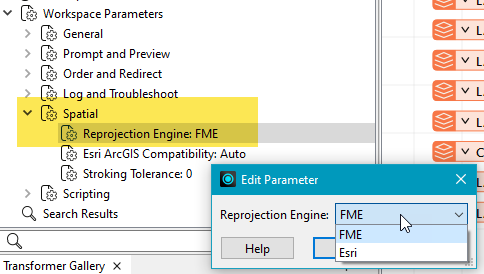
To perform a reprojection, FME typically uses the CS-MAP reprojection engine, which includes definitions for thousands of coordinate systems, with a large variety of projections, datums, ellipsoids, and units. However, GIS applications have slightly different algorithms for reprojecting data between different coordinate systems. To ensure that the data FME writes matches exactly to your existing data, you can use the reprojection engine from a different application.
To change the reprojection engine, Select Workspace Parameters > Spatial > Reprojection Engine. In the example shown, you can select Esri (but the selection here depends on your installed applications):
- The coordinate systems file coordsys.db in the FME installation folder contains the names and descriptions of all predefined coordinate systems.
- Some users may wish to use coordinate systems that do not ship with FME, and in those cases, FME also supports custom coordinate systems.
- Learn more about Working with Coordinate Systems in FME.
Table Parameters
Simplify Geometry
ArcGIS geometry has to satisfy certain constraints to be considered valid. For example, polygons must have more than 2 vertices. This parameter allows you to specify whether geometry that breaks those constraints will be simplified to ensure only valid geometry is written.
Note that simplifying geometries can be resource-intensive.
For details on the conditions for invalid geometry and how it is simplified, please refer to ArcGIS documentation: Simplifying a Geometry and Calling the Simplify Method.
Advanced
Features Per Transaction
The number of features written in each Edit Operation of an Edit Session. Data is sent to the server when each edit operation ends.
Default: 1000
Ignore Failed Features
This parameter tells the writer whether it should ignore features that would usually cause the translation to fail. This includes features that are topologically incorrect, are not supported by the writer, or conflict with the definition of the table to which it is to be inserted (that is, they are outside of the geometry envelope specified by the feature class). Additionally, the writer will also ignore polygons, donuts, or aggregates of polygons/donuts that cannot be reoriented.
The default setting is No, which means that failed features are not ignored and will cause the translation to fail when encountered.
Max Number of Features to Ignore
This parameter sets the number of features to ignore before causing a translation to fail due to a problematic feature. (However, the translation may still fail for other reasons.)
Values: To ignore all failed features: -1; otherwise 0 or a positive integer.
Dump Failed Features to File
This parameter allows you to store the failed features to an FFS file for later viewing.
Failed Feature Dump Filename
This parameter allows you to specify an FME Feature Store (FFS) file to store any failed features.
This file will be created automatically, but will only be created if there is a failed feature.
This parameter is required when Dump Failed Features to File is set to Yes.
Values: path and filename
If either the path or the filename contains a space, the value must be enclosed in double quotation marks. The filename must end in the extension .ffs.
Enable Fast Deletes
Enables fast deletes when feature operation is set to Delete.
- Yes – Combines WHERE clause predicates up to a limit of 32K characters at a time. If the limit is exceeded, a new query to the table is created.
- No – Slower deletes by creating a query to the table for each feature.
Preserve GlobalID
Determines whether to copy the GlobalIDs from the source table to the destination table, or generate new GlobalIDs for the destination table. The feature operation must be set to Insert.
- Yes – Preserves the existing source feature type GlobalID attributes.
- No – Auto-generated GlobalIDs are assigned to features that do not have one.